Pulsars
Detection of bright pulsars
A star is like a giant nuclear reactor, fusing hydrogen nucleii together under intense gravitational pressure, to form helium. The process gives off light and a tremendous amount of energy as heat. During the main part of a star's lifecycle, the violent outward force from the nuclear reaction is balanced by the gravitational inward pull due to the star's immense mass, and the star is stable.
As the star's fuel begins to dwindle, and the outward force from the fusion reaction begins to diminish, gravity overpowers the outward force and the star collapses. A supergiant star that collapses inward can suddenly brighten as it burns it's remaining fuel, creating a supernova. After the supernova has exploded, the remnants of the star become compressed into a tiny space, sometimes so dense that light cannot escape, and this becomes a black hole. Sometimes they leave behind a smaller star comprised entirely from neutrons called appropriately a neutron star.
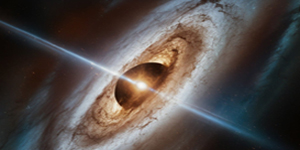
The huge star, which may have once been up to a billion kilometres in diameter and would have rotated slowly, is now compressed into a sphere in the order of 20 kilometres in diameter and the conservation of it's angular momentum causes it to spin much faster, in the same way that an ice skater can spin faster by bringing their arms inward. The neutron star may rotate several times per second about it's axis. A neutron star may also emit intense broadband radio energy and the powerful magnetic fields at the poles focus the radio waves into a sweeping narrow beam, much like the light from a lighthouse. A rapidly rotating neutron star that emits a beam of radio waves is known as a pulsar.
If by some chance this narrow highly energetic beam of electromagnetic radiation crosses the Earth's path, it can be detected by suitable sensitive equipment, however it is a great challenge for amateurs radio astronomers because pulsars are very distant and by the time the beam reaches Earth it is weak and the signal is hard to distinguish from background noise. However despite the challenges many amateur radio astronomers have been rewarded for their efforts in detecting radio emissions from some of the brighter pulsar sources.
Pulsars were discovered in 1967 by Jocelyn Bell Burnell during her PhD studies, when she noticed repetitive data from a newly commissioned radio telescope called the Interplanetary Scintillation Array, that she had helped to construct in Cambridge, UK. As the signal drifted with regular precision across the array it was confirmed to be of celestial origin but the nature of it was unknown. The signal fitted well with the idea of a radio beam emission from a highly magnetised rotating white dwarf, hypothesised by Pacini in 1967, just prior to Bell Burnell's discovery. Further observations confirmed the existence and nature of pulsars and since 1967 several pulsars have been catalogued.
The radio telescope array that first detected pulsars covered an area of 4 acres or 16,000 square metres, however since 1967 electronics have become smaller, cheaper and less noisy. Amateur astronomers have detected pulsars using software defined radios (SDR) and in the side bar is a paper about small aperture pulsar detection. It may be rewarding but it requires substantial signal processing and isolation from radio interference.
An alternative way to detect pulsars is to utilise a large radio dish online. Study time can be purchased or in some cases may be free to students, during which you can control and command a radio telescope remotely, defining the target and various other settings, or participate in a small group to study pulsars.
This is a list of a few possible organisations that allow researchers and other groups access to observation time:
Very Large Array (VLA), USA: Primarily for scientific proposals. No direct commercial sales, but collaborations with industry can happen through partnerships.
Green Bank Telescope (GBT), USA: Mostly scientific proposals, but some outreach and educational programs allow limited access.
LOFAR (Low Frequency Array), Europe: Offers access to researchers through proposals; some outreach projects enable public participation.
Swinburne University’s VLBI Telescope, Australia: Offers remote observing for educational purposes.
Private Radio Telescopes: Some smaller or private observatories may rent time or offer services commercially
At the moment I have neither the equipment nor the time to study pulsars. It is a possible future project, but I have included pulsars because they are an important radio sky object. The links in the sidebar may help some amateur radio astronomer in their quest to detect a pulsar.